
By Nancy Adams
This guest blog discusses activity linked to the Founders and Funders exhibition hosted by the John Rylands Library and is co-hosted by the Race, Roots, and Resistance collective.

On the 27th October 2023, I joined with the public engagement team at the John Rylands Library, Harry Eyre of the Ahmed Iqbal Ullah RACE Centre, and Matthew Stallard of Global Threads, to host a “Collections Encounter” that offered visitors a closer look at items relating to the Founders and Funders exhibition. These included McConnel and Kennedy’s order book, samples of raw and worked cotton from the Science and Industry Museum, and archive materials from the RACE Centre.
The session explored the links between the history of cotton manufacturing, enslavement, the City of Manchester, and the University of Manchester. We also hoped to challenge the idea that there is no continued legacy of the slave trade and initiate discussions on “What’s Next?” – considering possible actions the University should take in light of thee legacies highlighted in the Founders and Funders exhibition – of which I was a researcher and co-curator.
The encounter was held during the October half term, meaning visitors of all ages were visiting the library. The diverse objects across the tables attracted a large number of interested people across the afternoon. The cotton samples, which included plants, raw fibres, and the final product of a spool of cotton, were particularly popular.
Younger visitors especially enjoyed the tactile experience of feeling the samples at each stage of refinement. Many of the children I spoke to had already learnt about cotton mills and the process of spinning cotton in school or at other museums, including an 11-year-old who offered me detailed instructions on ginning, carding, and spinning! However, the majority had not learnt about where the cotton spun in Manchester came from or the dependence of the cotton industry on transatlantic slavery.

The cotton plants also offered an interesting connection to the Rylands as, on closer inspection, each intricate light fitting in the library is modelled a cotton plant. Many visitors already knew the relationship between Rylands and the cotton industry.
However, by comparing the real cotton plants to the elaborate light fittings throughout the building, visitors were directly confronted by the impressive and ornate physical legacy represented by the library itself, which pointed clearly to the vast wealth of individuals like Rylands and other university funders with links to the cotton industry.

The table shown in the image above, entitled “Cottonopolis”, aimed to highlight Manchester’s dependence on cotton manufacturing, an industry underpinned by transatlantic slavery. McConnel and Kennedy’s order books were an excellent starting point for discussing the relationship between Manchester and slave-grown cotton.
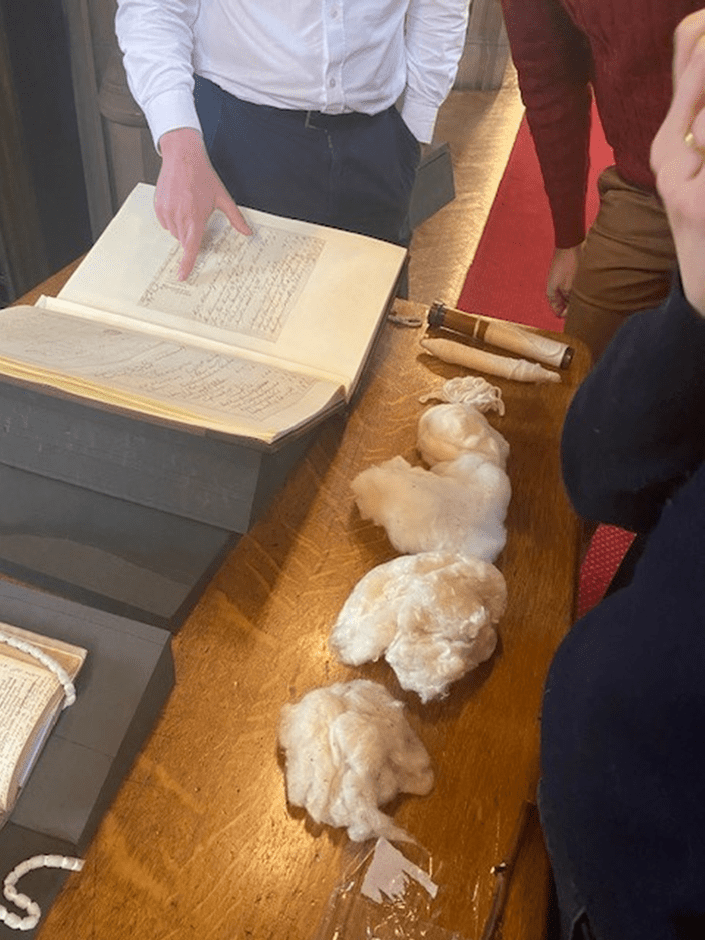
As visitors attempted to decipher the intricate handwritten notes, they could piece together the long process of bringing slave-grown cotton to the factories of Manchester and the multitude of people involved in the process.
The page we reviewed detailed the process of importing individual bales of cotton from Savannah, Georgia and the subsequent payments made upon arrival in England, including dock dues and commission paid to Manchester bankers. Visitors tended to remark on the number of people who profited from this process, which prompted discussions about the far-reaching financial legacies of slavery.
As I spoke to tourists and residents of Manchester, it was interesting to compare their understanding of the relationship between Manchester and slave-grown cotton. One woman told me her mother had worked in cotton mills during the Second World War. She told me about her mother’s experience as a mill worker and how she used to collect fibres of cotton from her mother’s coat.
She also reflected on the city’s important relationship with the cotton industry until its decline in the 1980s. When considering the question of “What Next?”, she felt it was necessary to continue to unpick the legacy of the slave trade in Manchester considering the number of lives impacted by the cotton industry and Manchester’s identity as “Cottonopolis”.
The second table explored how abolition resulted from rebellion and resistance of the enslaved and solidarity in the UK. Many visitors came to the table with some understanding of the abolition movement, specifically the role of Wilberforce and anti-slavery movements in Manchester. The Narrative of the Life of Henry Box Brown was a popular item on this table.

Henry “Box” Brown escaped slavery by hiding in a packing crate that was shipped from Virginia to Pennsylvania in 1849. The crate was approximately 1 meter long, 0.8 meters deep and 0.6 meters wide. Brown toured Britain and came to Manchester, where he eventually settled and published the very book we presented. While he was touring, he re-enacted his escape and gave anti-slavery speeches.
Another popular item on the table was a “Chart of the World” in which the author made economic arguments for the abolition of the slave trade. The map’s author believed that eliminating duties from East Indian sugar would help end slave labour in the West Indies.
However, he had interests in East Indian sugar and stood to benefit from that reduction in duties. These sources stimulated discussion about different forms of resistance to the slave trade and expanded visitors’ understanding of the contributing factors to abolition.
Our discussions on resistance continued with an examination of The Demerara Martyr, which provided an account of the Demerara Rebellion of 1823, led by Jack Gladstone, an enslaved man on the Success plantation. This uprising was a key factor in influencing the the abolition of slavery across the British Empire in 1833.

Residents of Manchester tended to have a strong sense of the role Manchester played in the abolitionist movement and mill workers’ support for Abraham Lincoln during the U.S. Civil War and Lancashire Cotton Famine. The first two tables offered alternatives to this more positive memory of Manchester’s relationship to the institution of slavery.
Most of the discussions around “What’s Next?” focused on Manchester and the legacies of slavery in the city – mainly physical reminders like university buildings and old cotton mills. Standing in the Rylands’s imposing Reading Room reinforced the idea that its founders and funders amassed vast wealth from the cotton industry and the slave trade.
A couple I spoke to, who were visiting Manchester for the first time, echoed these sentiments. They had just spent the morning walking around the old mills in Ancoats, including the site of McConnel and Kennedy’s mills. Learning about this local history resonated with them, and they felt that it was important that the university continued to share information about the legacies of slavery in Manchester.
Another theme in the discussions about what actions the University could take next centred around giving back to the local community and increasing access to education.
A woman I spoke to initially felt that applying today’s moral standards to people’s actions in the 1800s was impossible. We discussed her experiences of higher education – she had an MA in international human rights and had started her PhD in Tunisia. She hoped to continue her studies but had found a lack of accessibility in UK universities.
These sentiments are also reflected in many of the feedback cards written on the day, as visitors moved onto the third table, which featured collections relating to global majority communities near the University of Manchester buildings.

ABOUT THE AUTHOR
Nancy Adams

Nancy Adams is a part of the Emerging Scholars programme at the University of Manchester. She became involved through her participation in the “Race, Migration & Humanitarianism: Legacies of Slavery and Colonialism in the Modern World” module, as part of her MA in History and went on to complete research for the Founders and Funders exhibition. Nancy currently works for the Science and Industry Museum in Manchester as a Prospect Development Executive.
 GLOBAL THREADS
Leave a comment