
By Ella Sinclair
This article first appeared in the Summer 2023 issue of Traces, the newsletter of The Centre of the Study of the Legacies of British Slavery
The widespread Black Lives Matter protests that ensued after the racist murder of George Floyd led to an ‘awakening’ to the reality of racial inequality in Britain. However piecemeal and patchy this newfound insight may have been, it certainly marked a shift in tone: sweeping the nation’s racial history under the carpet was no longer a respectable option for British institutions.
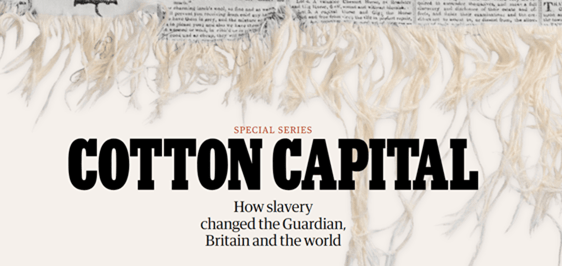
It was all out in the open. They had to do something. UK newspaper, the Guardian, is one institution that decided to ‘wake up.’ This is marked by the debut of their Cotton Capital series in March, which grapples with the organisation’s ties to transatlantic slavery.
Cotton Capital, a project three years in the making, is an ambitious attempt at an institutional reckoning with the legacies of British slavery. In the series, the Guardian re-tells the history of Manchester – or ‘Cottonopolis.’
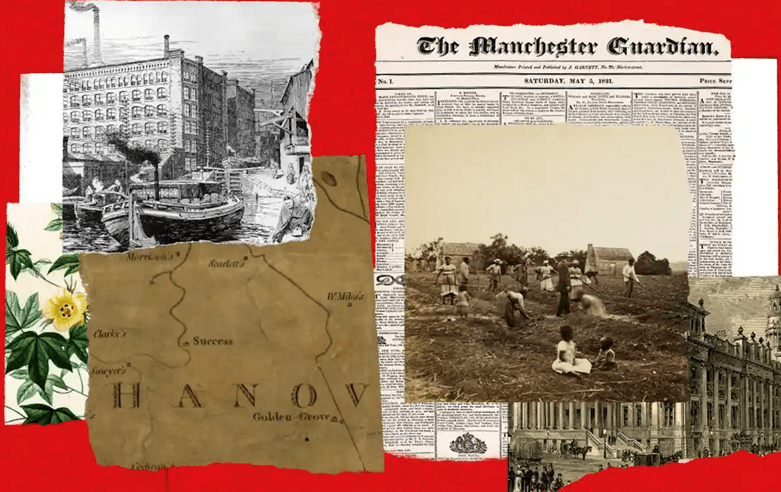
The project foregrounds the inextricable ties between Manchester’s mills and the enslaved labourers forced to work on cotton fields. As David Olusoga, historian and board member of the Scott Trust, points out in his series contributions – Britain’s industrial revolution did not solely take place in Britain.
In 2020, the Guardian’s owners, the Scott Trust, were spurred by the intensification of the Black Lives Matter movement to interrogate the publication’s past. The Manchester Guardian was founded in 1821 with money connected to the trade of cotton produced by enslaved people in the Caribbean and the US. The series explainer specifically notes the 2020 toppling of the statue of Edward Colston motivated this exploration of their own tangled history with transatlantic slavery and begin a process of restorative justice.
“The Manchester Guardian was founded in 1821 with money connected to the trade of cotton produced by enslaved people in the Caribbean and the US“
The Guardian’s bold reparative strategies exist alongside other landmark attempts in the UK. In January, the Church of England apologised for its role in transatlantic slavery, setting up a £100m compensation fund. The Bank of England similarly apologised, and opened their two-year ‘Slavery & the Bank’ exhibition in 2022. The National Trust and a number of universities have also begun to investigate their financial connections to enslavement. Some individuals descended from slave-owners, like the Heirs of Slavery group, are taking reparatory action into their own hands.
All this work is incomplete, and perhaps raises more questions than it answers. Who sets the reparations agenda? What voices and perspectives are heard and privileged? Each institutional approach is different, but the critical question – how do we engage with the ‘traces’ of the past – runs through them all.
More encouraging efforts, like the Guardian’s, are prepared to engage with descendant communities, such as the Gullah Geechee people, the descendants of the enslaved people who picked the cotton fuelling Manchester’s industrialisation. Other efforts, whilst they may be well meaning and impactful, are inevitably complicated by the fact that they are able to centre themselves in these discussions precisely because of the legacies of wealth and privilege accumulated as a result of involvement with British slavery.
Despite these institutional attempts to repair the legacies of British slavery, Britain’s wider societal context remains hostile to restorative justice. In 2014, Britain rejected Caricom’s reparations plan. Prime Minister Rishi Sunak recently refreshed the government’s refusal to apologise for Britain’s role in the slave trade or engage in reparatory action with the Caribbean.
“All this work is incomplete, and perhaps raises more questions than it answers. Who sets the reparations agenda? What voices and perspectives are heard and privileged?”
Cotton Capital contributors such as journalist Samira Shackle have interrogated the incessant backlash with which reparatory work is met – acknowledging the engulfing culture war that surrounds this work in Britain. Dr Cassandra Gooptar, a researcher commissioned by the Scott Trust, also notes the importance of re-humanising the narrative around slavery.
The Cotton Capital researchers navigated archives devoid of humanity in such a way to identify and piece together the lives and stories of the enslaved people linked to the Guardian’s founders. The series also spotlights stories of resistance from black Mancunians, such as activist Elouise Edwards, as well as African American abolitionists, celebrated under the series section titled ‘The Radicals.’ Cotton Capital also outlines the Guardian’s bold plan for restorative justice.
The time, thoroughness, care and sheer resources fuelled into Cotton Capital marks a welcome shift away from more tepid institutional acknowledgements of the past. Perhaps the Guardian has set a precedent. As we move forward, and as acts of restorative justice progress and more British institutions follow suit, we must think critically about how they narrate the legacies of transatlantic slavery, and which power dynamics they uphold or dismantle.

In her contribution to Cotton Capital, the renowned historian Olivette Otele points out that reparative actions often begin and end with institutions – but what about society as a whole? Otele’s point urges one to think about the limits of these institutionally (and regionally) bound programmes of restorative justice that grapple with a societal or nation-wide phenomenon, that being Britain’s legacy of slavery. Will, or can, the emphasis ever shift to that of a national reckoning? Do institutional efforts cloud this national responsibility?
Otele’s comments also raise questions about the ways this work is received more widely at a mainstream societal level. The Daily Mail quickly labelled Cotton Capital ‘the simple-minded war on history’. Commenters on this particular piece bemoaned the supposed erasure of history inflicted by the Guardian’s restorative justice efforts. Upon the publication of a report investigating their organisation’s links to colonialism and slavery, the National Trust in 2020 was swiftly accused of having a “political agenda” and attempting to tell “a certain version of history.” These examples make clear that great care must be taken in reparative efforts, lest they be mired in the ongoing ‘culture war,’ but also prompt one to question the realisable impacts of ambitious restorative justice efforts, and what they can achieve in a disparaging societal context.
The Guardian has certainly covered a lot of ground since 2020. Perhaps this, alongside other institutional reparative efforts, will spur a more accurate national remembering in Britain – creating an imperfect but impactful restorative justice movement in years to come.

ABOUT THE AUTHOR
Ella Sinclair

Ella Sinclair is a postgraduate student at University College London studying the Race, Ethnicity and Postcolonial studies MA in the Sarah Parker Remond Centre for the Study of Racism and Racialisation. Her research primarily focuses on slavery in the Caribbean. She is also a freelance journalist focusing on race, racism, politics and social justice. She has written for The Lead, gal-dem and The Voice. Find her on Twitter.


Leave a Reply